

Ramata Diallo was 16 when she had to leave school. At 30, she is back in class in northern Senegal, studying math and human rights in Pulaar, her own language, alongside her husband.

MAPOUDJI, Senegal
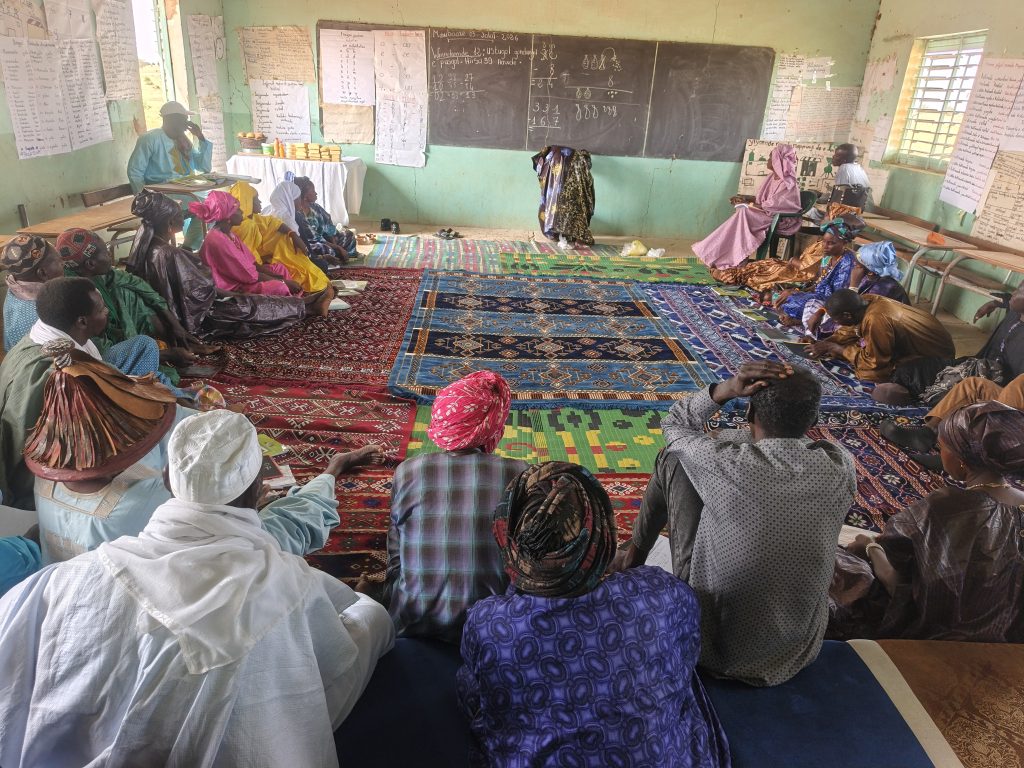
Ramata Diallo walked to the blackboard and chalked the answer to 98 minus 29. Sixty-nine. “Well done,” said the facilitator, Penda Hamady Sow, and the other 35 learners applauded. Among them sat her husband, Oumar Sarr, minding their 1-year-old son.
The class has 20 women and 16 men, aged 30 to over 60. They sit on mats in a room of the village primary school, a room built for children.
Ms. Diallo had sat in a classroom before. In 2012 she was 16, in her second year of middle school, when she married. She became pregnant the same year.
I dropped school against my will,” she said.
Her story is common. In Senegal, 30 percent of women aged 20 to 24 were married or in a union before 18, according to the 2023 Demographic and Health Survey.
I regret that my parents did not send me to school,” Mr. Sarr said. “It is true that there was no school in my village at that time, but they should have sent me to the closest one.
Milk brought the couple to this room. Ms. Diallo farms and herds, and she is one of the Mapoudji women who sell milk to Laiterie du Berger, a dairy in Richard-Toll that buys from herding households across the area. In May 2025, the dairy began paying for a three-year community education program in 25 villages where it collects, taught in Pulaar and run by Tostan.
The reason lies in the milk market. In 2022, Senegal produced only half the milk it consumed, according to the national statistics agency. The rest arrives as imported powder, almost all of it from Europe. A dairy that buys from local herders competes with that powder every day, and its business rests on the people who supply it. The dairy’s reasoning is that a producer who can read and count can understand a contract and check what she delivers, and that producers who are organized and can settle their disputes deliver on time and in the quantities agreed. It put that reasoning in writing when it agreed to fund the classes.
Who pays for the skills of the people at the far end of a supply chain is a question usually left to the state and to donors. Here, the buyer has put it on its own books.
To the arithmetic learned in class, the dairy adds digital training, so producers can track the milk they deliver and keep their own accounts. Ms. Diallo now writes her own receipts and works out her income and profit.
I am learning more things right now, and faster than formal school itself,” she said.
The class also covers what no supply contract asks for. She can list her rights to education, health, protection and land ownership. She has learned that her four children have rights too, and it has changed how she talks with them. She is careful now, she said, not to step on their rights. She names her duties as well, from protecting the environment to schooling her children and looking after her health.
What she learns travels. She says she passes it on to friends and relatives in Mapoudji and nearby villages, people who have no place in the class.
None of it comes free. She farms, herds and milks, and the class takes its hours from the same day.
“I have always regretted having suspended my studies,” she said. “Now I don’t anymore.”