
Can you learn to govern outside a classroom?
A review of the research published this year argues that learning outside school can prepare Africans for public life. In three West African countries, women who left school or never went have shown what that looks like.

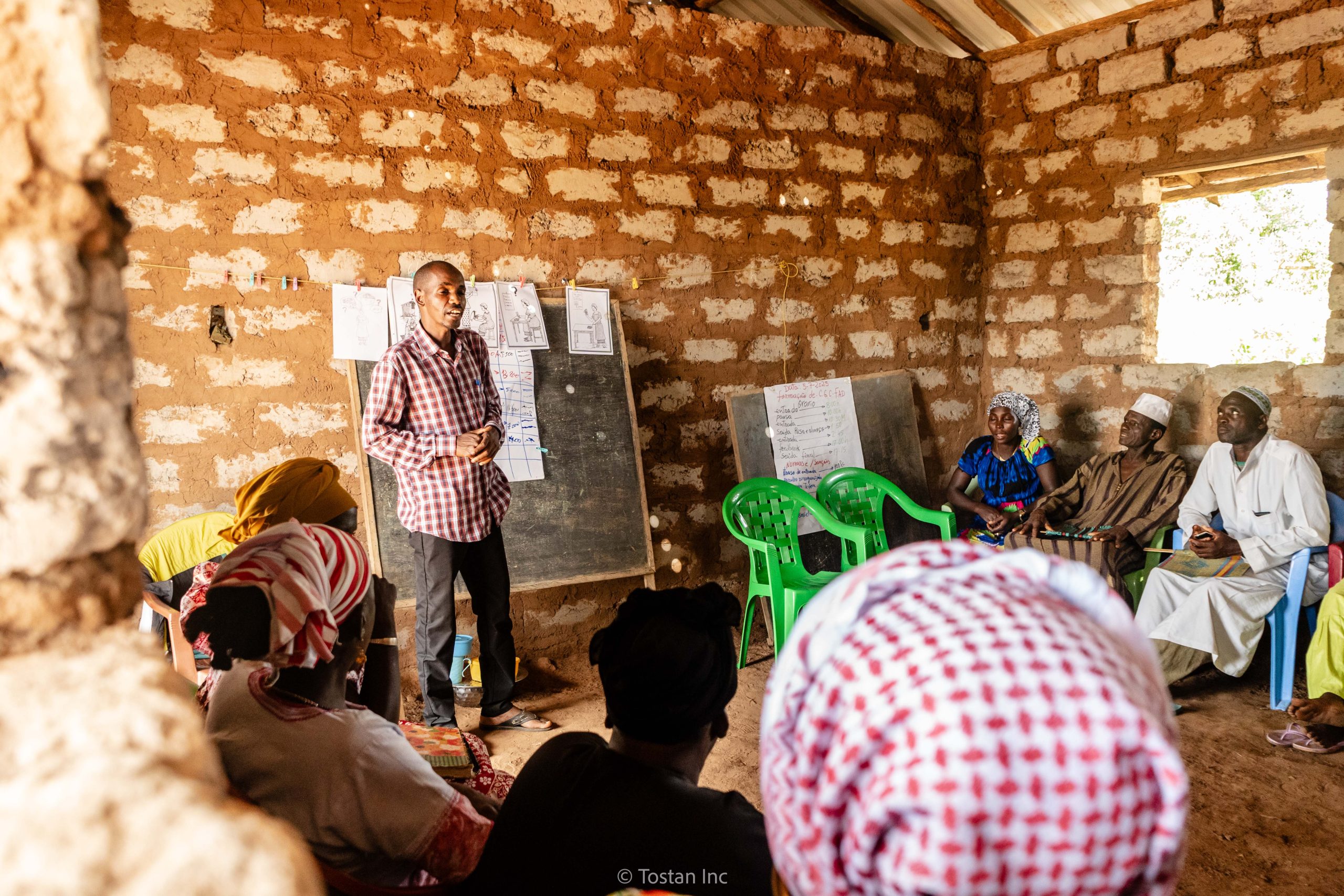
THIÈS, Senegal — In Pirada, Guinea-Bissau, Fatimata Madina Baldé’s schooling ended when her family arranged her marriage. Her way back to learning was a class taught in Pular, her own language, by Tostan’s Community Empowerment Program (CEP). Today she trains facilitators and leads radio discussions on early marriage.
She left school but did not stop learning. Can learning like hers prepare people for public life, in places where school has not? A paper published this year asks exactly that.
The question matters most for the young. Africa’s median age is about 19, the lowest of any region, and the continent is governed by some of the world’s oldest leaders.
Young Africans are also the most schooled generation the continent has produced. Sixty-four percent have at least some secondary education, compared with 35 percent of people 56 and older, according to Afrobarometer. Yet they are less likely than their elders to vote, attend a community meeting or contact a local leader.
Something between the classroom and the ballot box is missing.
In the Journal of Academics Stand Against Poverty, the researcher Grace Gondwe argues that non-formal education, meaning structured learning outside the school system, can supply part of it. Her paper does not report new fieldwork. It reviews existing studies and evaluations, and it examines two programs closely.
The first is Solar Mamas in Zanzibar. There, women with little or no schooling spend six months training as solar engineers with India’s Barefoot College. The skill turns into standing: a woman who brings electricity to her village gets a voice when the village decides things.
The second is Tostan’s program, which works on a whole community at once. Participants, Gondwe writes, learn to negotiate, settle disputes and reach decisions together across lines of gender, age and status.
Gondwe treats these as two different routes to civic life. In Soudiane, a village in central Senegal, one woman took both. Marieme Bamba, who never went to school, was elected in 1999 to coordinate the management committee her village formed through Tostan’s program. Later she trained at Barefoot College and came home to bring solar light to 150 households.

In The Gambia, the results of this kind of learning were put to a vote.
In 2017, the government’s Women’s Bureau held grassroots elections to choose one woman from each district for the National Women’s Council, which advises on policies affecting women and girls. Each district covers 40 to 50 villages. In all seven districts of the Upper River Region, according to Tostan, voters chose a woman who had been through its program. Many had led their village’s management committee. Several said that before the classes, they had rarely spoken in public.
The government has taken note. Speaking at a Tostan seminar in 2021, Kajali Sonko, deputy permanent secretary at the Ministry of Women and Children’s Affairs, said the program had “greatly enhanced communities especially women and girls” in the Upper River Region in human rights, governance, health and education. That finding, he said, was confirmed by the Women’s Bureau’s own quarterly field monitoring.
Stories like these are not proof. The strongest numbers come from Senegal, and they are two decades old. In 2006, the political scientist Michelle Kuenzi published a survey of 1,484 rural Senegalese. She found that people who had gone through non-formal education in their own languages took part in political and community life at least as much as people who had been to school, and generally more.
That finding has limits. A 2023 study in Political Science Research and Methods found that in Senegal, education increased political participation only when democracy appeared to be under threat. Learning may prepare people to act. Circumstances seem to decide when they do.
Gondwe is also direct about Tostan’s room of improvement. The model depends on well-trained facilitators and on communities staying involved for years. She writes that attempts to expand it too quickly have already cost it quality and consistency, and that growth at that pace risks reducing a real process to a symbolic one. For that claim, she cites a 2017 report on social norms.
Tostan accepts part of the point.
This statement is partially true,
said Yussuf Sané, coordinator of Tostan’s Program Leadership Team.
Expansion without standardization and harmonization is a recipe for failure.
Tostan has since written a manual of procedures for its national teams to follow as they expand, he said, and supervisors accompany each facilitator at least three times a month. Facilitators still speak the community’s language and live there for the full three years.
Growth itself has changed, too. Instead of only
Replicating the full CEP in more communities,
said Aïssé Kane, Tostan’s Sharing and Mutual Learning Officer, the organization increasingly teaches its methods to local organizations that adapt them to their own contexts, as in its recent work in Benin and Ethiopia.
Gondwe’s larger argument concerns Africa’s place in the world. The African Union became a permanent member of the G20 in 2023. What the continent does with that seat, she argues, will depend less on how young its people are than on whether they are ready to lead. The African Union’s long-term plan, Agenda 2063, describes the Africa it wants as one whose development is “people-driven,” relying especially on its women and youth.
The plan does not say where those people will learn to lead.

Before she trained as a Tostan facilitator, Fatoumatta Jabbie said, she was “shy and ashamed to speak in public.” In 2017 she campaigned across her district in the Upper River Region and won a seat on the National Women’s Council. She later became its vice-chair.
“I promised women of my area that they will have a stronger voice at the council when I am elected,” she said, “and that is exactly what I am doing.”