

THIARAP, Senegal — Under a makeshift shelter that offers little relief from the heat of this June morning, Samba Baldé turns a string of prayer beads slowly between his fingers. Around him, village elders fan themselves against the humid air settling over Thiarap, a small rural community in Fouladou, southern Senegal. In a matter of days, this village and 26 others across the Coumbacara district will gather for a big event: a public declaration ending female genital cutting and child marriage in their communities. At 65, the village chief remembers a time when the practice was simply considered part of a girl’s life.
For us, it was custom. We didn’t think we were doing something wrong, He says.
The subject remains especially sensitive in the Kolda region, where FGC prevalence reaches as high as 63.6 percent, among the highest in Senegal, according to UNICEF. Senegal outlawed the practice in 1999, with penalties of up to five years in prison for anyone who performs or orders it. Yet the practice persisted because adherence to community tradition mattered more in daily life than compliance with the law.
A few years after the law passed, that gap produced a moment Thiarap still remembers. Police came from Kolda, the regional capital, and gathered the village’s elders (men and women together) into a truck bound for the city, to be questioned over a cutting ceremony that had just taken place. After the investigation, seven people were found responsible, among them the village chief himself, and were sentenced to four months and ten days in prison.
Yahya Diao, in his late sixties now too, was brought in with the others for questioning but was not among the seven sentenced. He describes what he saw during the hearings.
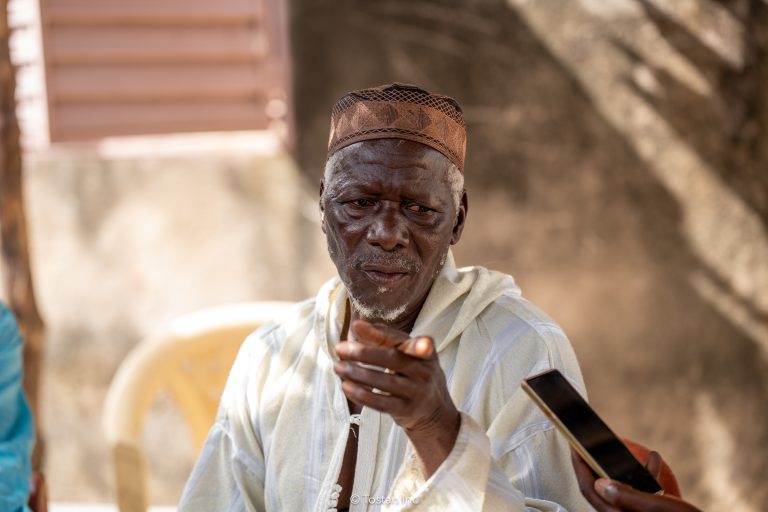
They put us all in a truck, the elders together,” he says. “We went to the hospital, the cutters too. The doctors examined the girls and confirmed it had happened.
The punishment shocked the village without changing much about how it lived.
We were punished, but we didn’t really understand why,” Baldé recalls. “We were told it was forbidden, but no one took the time to explain the consequences of the practice.
Nobody in Thiarap decided to defy the law outright. In villages like this one, far from the roads authorities travel and the offices where the law is enforced, families who wanted to continue the practice simply did, away from view, and a jail sentence handed down in one village doesn’t necessarily reach the next one over. FGC didn’t disappear from Fouladou so much as retreat from sight, a pattern Tostan has documented elsewhere in Senegal, in villages where isolation, not defiance, kept the law from ever really arriving.
Usually, when information comes from higher up, only people in the cities are told,” Diao says. “No one came to explain it to us.

The turn came in 2024, when Thiarap joined Tostan’s Community Empowerment Program. Sessions were held in the language people spoke at home, led by people from their own community. Residents examined human rights, health, education, and the consequences of violence against women and girls together, with women, men, young people, religious leaders, and traditional authorities in the same room.
Baldé says no one forced their hand or threatened them a second time. What changed, he says, was that for the first time since the arrests, someone actually sat with them and laid out why the practice caused harm, and it was only then that the damage became clear to him; damage he hadn’t recognized before, and he began to regret it.
We didn’t abandon the practice because we were afraid,” he says. “We abandoned it because we understood.
On June 14, 2026, Thiarap participated alongside more than 500 participants from 27 communities in Coumbacara district for a public declaration against FGC and child marriage.
You can send everyone to jail,” Diao says, “but without understanding, people will still hold on to what they know. Because they believe they are right. Because no one explained anything to them, and no one discussed it with them. Then one day, someone comes and tells them to stop a practice their grandfathers and grandmothers did for centuries.