
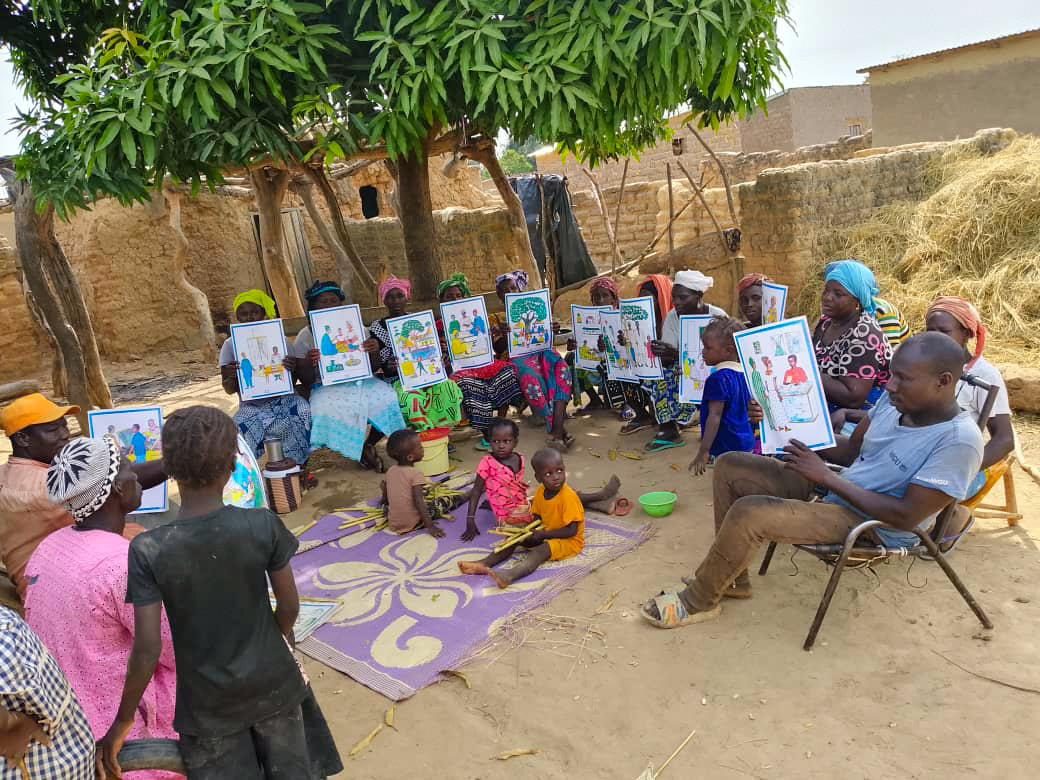
In the village of Bolé in southern Mali, disputes between farmers and herders once followed a predictable and often destructive cycle.
During planting seasons, livestock would stray into cultivated fields overnight. By morning, frustrated farmers sometimes retaliated by poisoning animals grazing nearby. Each incident deepened mistrust and risked escalating into wider conflicts between farming and pastoralist communities.
This year, something changed.
Instead of poisoning three animals he found inside his field, Bandiougou, a farmer, brought them before the village chief through a local community peace committee. Hours later, the owner arrived and paid a 10,000 CFA fine — about $18 — and took the animals home alive.
Across parts of the Sahel and West Africa, tensions between farmers and herders have become a major driver of local insecurity and intercommunal violence. In parts of Mali and the wider region, disputes that begin over damaged crops or wandering livestock can rapidly escalate into intercommunal violence, displacement, and broader instability. Community-based mediation mechanisms like the one operating in Bolé aim to interrupt that cycle early by creating trusted spaces where disputes can be resolved before retaliation begins.

“Things have changed here,” said Minata Diakité, member of the Peace Committee of the Community Management Committee (CMC) in Bolé . “In the past, conflicts often led to retaliation. Today, people come to us first, and we use dialogue and listening to resolve issues before they escalate.”, she added.
Established and trained as part of the Tostan’s education program, the CMCs serve as frontline community structures responsible for early warning, inclusive dialogue, mediation, and the peaceful resolution of disputes at the family, village, and intercommunity levels.
Since launching its Community Empowerment Program in Mali in 2009, Tostan has progressively expanded its community-led peacebuilding approach across the Koulikoro and Dioïla regions, strengthening local conflict prevention through dialogue, mediation, and shared responsibility for human security. Between 2016 and 2022, 80 communities participated in the Peace and Security Module, contributing to the active resolution of more than 112 local conflicts.
The model combines practical mediation tools such as active listening, inclusive dialogue, conflict analysis, trust-building, and step-by-step negotiation designed to prevent escalation. Peace committees like the one Minata Diakité serves in are now the first responders to disputes involving land, family disagreements, youth tensions, and conflicts between neighboring villages.
But community members emphasize that the most important shift is not technical — it is relational. It is the ability to restore communication before divisions become entrenched.

“Cases of all types of conflict are now reported to the peace committees and resolved successfully,” said Kadiatou Sangaré, municipal councillor in Bolé. “The vestibules of village chiefs that once served as tribunals have now given way to peace committees.”
The program relies on inter-village exchanges, public meetings, and community networks to spread mediation practices across regions, moving faster than formal program expansion alone could. This has allowed mediation approaches to travel quickly across regions.
Beyond mediation, the Community Management Committees also collaborate with local authorities, traditional leaders, and sectoral services to support broader community organizing sanitation campaigns, improving school enrollment, supporting health initiatives, and coordinating vaccination efforts.
Across both sites, the approach connects directly to a priority ECOWAS Vision 2050 names under Pillar 1: strengthening mediation processes and multi-stakeholder dialogue as tools for preventing, managing, and resolving conflict. In that framework, community-level structures capable of interrupting disputes before they reach state institutions are central to regional peace architecture. The same document identifies pastoralist-farmer clashes as a driver of displacement and insecurity across the region.
In Bolé, Bandiougou’s decision to bring three animals before the peace committee rather than poison them was not exceptional. It was routine. That shift, from retaliation to procedure, is what peacebuilding looks like when it has taken hold.
In Massigui, a municipality in the Dioïla region, the same approach is showing similar results. Here too, peacebuilding structures initially created for conflict resolution are increasingly being used as platforms for collective action across other areas of community life. Adama Togola, the prefect, the state’s appointed representative for the area, highlights a real-time WhatsApp coordination system linking administrators, mayors, and community actors to improve transparency and early response.
The approach connects directly to a priority names under Pillar 1: strengthening mediation processes and multi-stakeholder dialogue as tools for preventing, managing, and resolving conflict. In that framework, community-level structures capable of interrupting disputes before they reach state institutions are central to regional peace architecture. The same document identifies pastoralist-farmer clashes as a documented driver of displacement and insecurity across the region.
In Bolé, Bandiougou’s decision to bring three animals before the peace committee rather than poison them was not exceptional. It was routine. That shift, from retaliation to procedure, is what peacebuilding looks like when it has taken hold.