
La Case du Caméléon : The communal house built from wood, clay and thatch where sessions take place in the village of Ebarak.
EBARAK, Senegal — In the Bassari communities of southeastern Senegal, mental health is rarely named. It is more often observed—in the silence of young men who left school too early, in tensions fueled by alcohol use or in the withdrawal of teenagers whose distress is mistaken for personality or disobedience.
In Kédougou, where isolation, unemployment, and artisanal gold mining define daily life, emotional struggle often remains invisible. Many young people spend their evenings in local bars, drinking palm wine as a way to cope with boredom, uncertainty, or loneliness. Talking openly about anxiety, sadness, or psychological distress can carry social consequences: shame, stigma, or silence from those closest to you.
Yet in some villages, that silence is beginning to shift.
In the village of Ebarak, the circle forms slowly beneath a large community structure built from wood, clay, and thatch. Known locally as La Case du Caméléon—The House of the Chameleon—the space was imagined by young people themselves as a place where communities could gather, create, and reconnect.Elders and youth gather inside La Case du Caméléon.
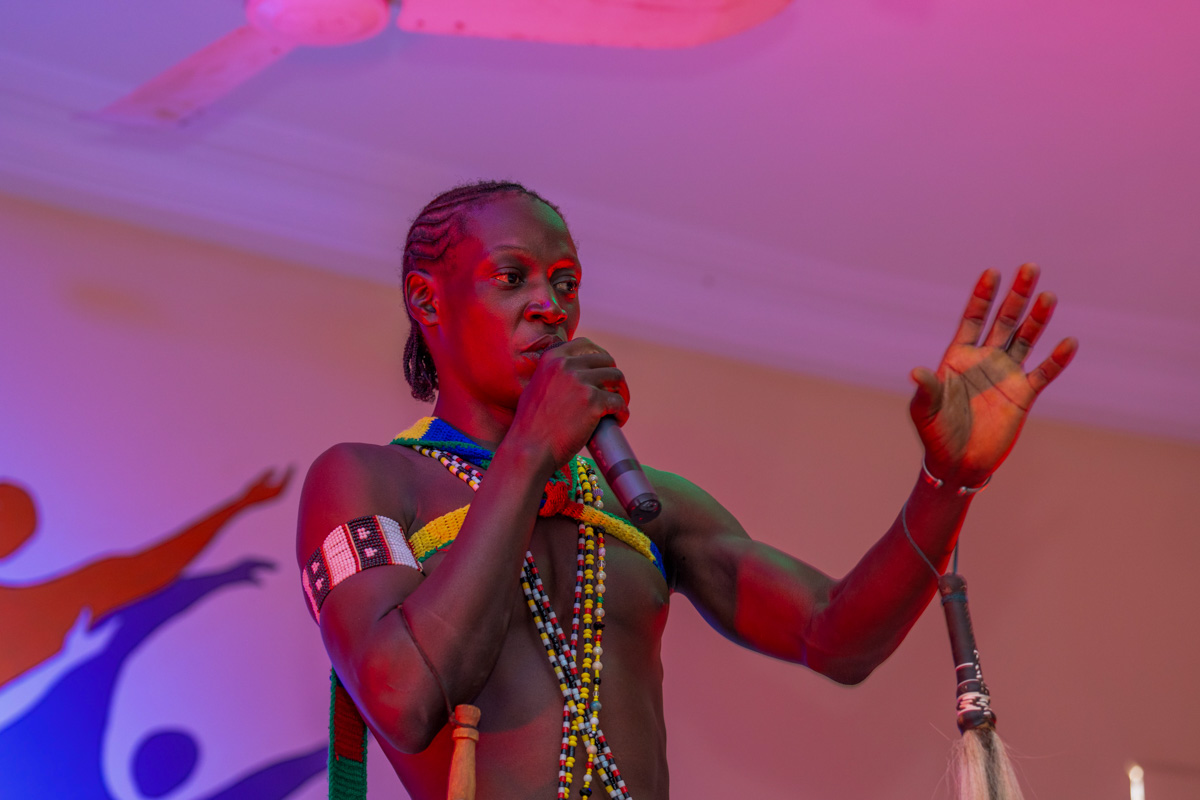
At first, the participants sit apart. No one calls what follows therapy. There are no clinical terms, no diagnoses. Instead, there is rhythm—hands clapping in unison, fragments of song, movement that begins cautiously before becoming more confident.
Then, something changes.
A young man speaks about pressures he has never discussed publicly. A girl describes exhaustion and isolation that she did not know how to explain before. Elders like Gaherademy Bindia, also known as Balingo, speak about a time when collective life itself helped young people navigate hardship.

“In the past, young people never grew up alone,” Balingo says. “The village square, the rites, the songs, and the elders were all part of their education. That is where each person learned to listen to others, to respect the community, and to find their place.”

Inside the circle, those reflections connect with lived experience. What is being recalled is not only tradition, but a way of living where belonging was continuous and support was embedded in everyday life.

The sessions are part of L’art du mieux-être / The Art of Well Being, a pilot initiative supported by Grand Challenges Canada and implemented by Tostan. But the initiative itself began with the community youth.
Concerned by rising alcohol use, social isolation, and the lack of safe gathering spaces in their communities, young people worked with Tostan to design an initiative centered on wellbeing through culture and artistic expression. Tostan then assisted in connecting the communities with partners who could support the project and strengthen its long-term vision.

Over nine months, Bassari youth aged 10 to 24 participate in interactive sessions rooted in Tostan’s community empowerment methodology. Through music, dance, storytelling, theater, and dialogue, participants exchange collectively on challenges affecting their lives, including unemployment, alcohol abuse, exclusion, loneliness, and social pressure.
The project also serves another purpose: preserving cultural knowledge at a time of rapid change.
The Bassari communities face increasing social and environmental pressures linked to deforestation and migration. Their spiritual traditions and collective practices remain deeply connected to forests, mountains, oral history, and intergenerational rituals that have long shaped community identity and belonging.
Inside La Case du Caméléon, those traditions are being revisited and transmitted. Young people learn songs, stories, dances, and cultural practices from elders while also creating new forms of artistic expression of their own.
“For the Bassari, tradition was never just a ceremony,” Balingo explains. “It helped young people face the difficulties of life together, surrounded by elders, music, and the community.”
Rather than separating mental health from this cultural context, the initiative works within it.
Participants in a creative session at La Case du Caméléon, Ebarak. Through art-making, young people find a language for what words alone cannot carry.
Facilitators trained by Alassane Seck use artistic expression as an entry point for dialogue.
“Often, there are young people who never speak and remain alone in their corner. But once they join the sessions, they begin to open up. Through music, art, and simple moments shared together, they find a space where they can finally express what they carry inside,”
Seck said during an interview at the Moussa Diop Psychiatric Clinic in Dakar, where since 1999 he has developed artistic expression workshops for people affected by emotional disorders.
Once trained, many young participants return to their own villages to organize discussions, performances, and creative sessions themselves, extending the conversations across communities.
“It is easier to speak when it is not called mental health,” Geremy Boubane,, one of the facilitators who was leading the session. “Through music, you can say things without fear.”
What emerges is not therapy in the conventional sense, but a space where people gradually feel seen, heard, and understood.
The transformation is subtle but significant. Parents describe changes in communication at home. Young people speak more openly about stress, alcohol use, and isolation. Elders participate in conversations that rarely took place publicly before.
In Senegal, where mental health services remain limited, particularly outside urban centers, such spaces are increasingly rare and increasingly necessary. The country counts nearly 6 million young people between the ages of 10 and 24, yet stigma and lack of access continue to prevent many from seeking support.
In the Bassari community, healing does not begin in a clinic.
Sometimes, it begins in a communal house—with rhythm, movement, shared stories, and the possibility of finally being heard.