
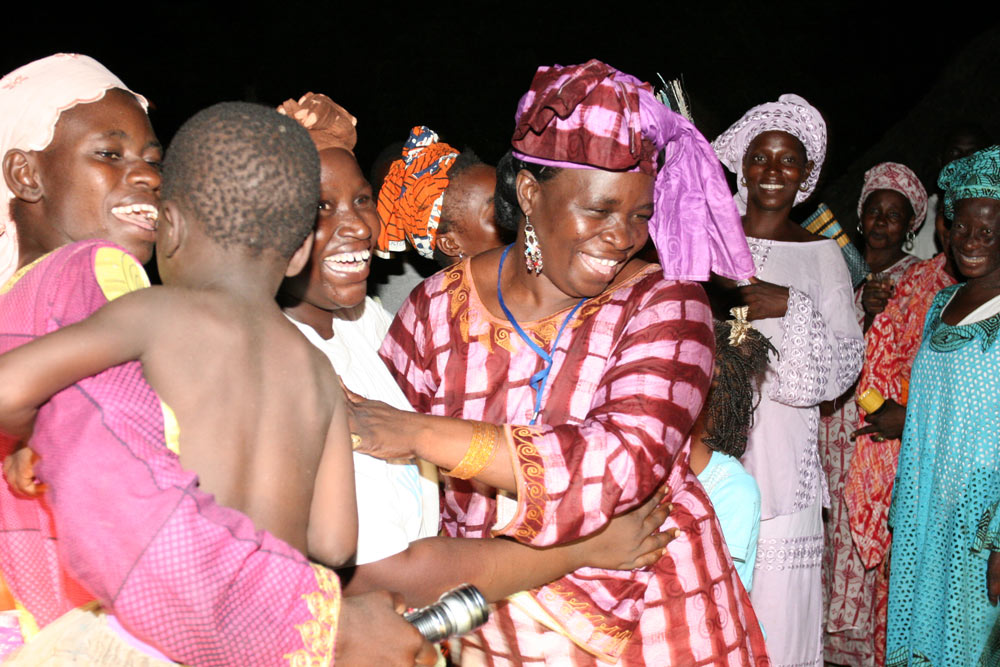
SOUDIANE, SENEGAL — In this village in central Senegal, where the sun beats down on thatched roofs with relentless intensity, night is no longer synonymous with darkness. Since 2010, solar bulbs have illuminated the compounds, the narrow pathways, and the huts where people study, cook, and dream. Behind this new light stands a name known by everyone: Mariama Bamba.
From Village Woman to Messenger of Change
In her early fifties, Mariama Bamba belonged to that quiet lineage of Senegalese women whose stories are rarely written in books, but rather etched into the lives they transform. Before Tostan, she cultivated groundnuts and sold millet in the market of Ndiob. Nothing seemed to foreshadow that she would become a respected community leader. Then, in 1999, she was elected coordinator of the Community Management Committee. From that moment on, she began traveling across Bambara villages, raising awareness about human rights, hygiene, and health, and especially about promoting the abandonment of Female Genital Cutting and Child Marriage.
A Solar Pioneer
Though she never attended school, Mariama Bamba became one of the first Senegalese women trained at the Barefoot College in India. For six months, she learned how to assemble and repair electrical circuits, batteries, and cables. When she returned home, she installed the first solar kits in 150 households in her village and trained other women and girls of her community in solar panel instalation.
This clean energy replaced kerosene lighting, reduced carbon emissions, and helped limit deforestation caused by the search for firewood.
Yet beyond electricity, she sparked a profound social transformation. Light brought families autonomy, hope, and dignity. Thanks to her work, children can now study at night, women can extend their income-generating activities, and the entire village has rediscovered confidence in its own potential. Today, Mariama inspires other women to learn, to lead, and to transform their communities in turn.
National Recognition
On March 8, 2022, at the Grand Théâtre of Dakar, she received the Pioneer Woman Award. On that day, it was the invisible women of Senegal who took the stage with her — those who illuminate, those who awaken, those whose voices have rarely been heard, yet who transform their environment and their communities.
Her story reminds us that the advancement of equality and sustainability can emerge through light, education, and concrete action — inspiring generations of women to become agents of change themselves.
In an era of global uncertainty, Mairama’s work ensures that Soudiane’s progress is sovereign and self-replenishing. The light in this village no longer depends on external aid; it is powered by the sun and the collective efforts of the community below. Mariama has lit the spark; she has proven that when you empower one woman with a circuit and a dream, you don’t just light a room—you launch a movement of dignity that will shine for generations to come.”